Scotland, by the Dram
Updated: Sep 22
Less than an hour into my first trip through Scotland, I pulled over to feed carrots to Highland cows.
I had places to be. I was supposed to be driving north toward the Isle of Skye, where Talisker Distillery—and the first serious whisky tasting of my trip—was waiting. Instead, I was standing beside a field trying to win the attention of cows with massive bangs. I left with butter biscuits shaped like the coos and very little urgency about getting back on the road.
This would become a pattern in Scotland.
I’ve been to Scotland twice now, with a third trip already in the works. I have planned those trips around distilleries, hotels, ferry schedules, and restaurants. What I remember just as vividly are the things that happened in between: Highland coos that made me pull over; lambs that brought me to a stop, sometimes dangerously along the road; a snowstorm that put an obstacle in my first trip; and wind strong enough to nearly blow me off a mountain.
Scotland has the sort of charm and mysticism that feels like it belongs in a fantasy novel. But what keeps drawing me back is that it has never particularly cared about the Scotland I planned to see.
The Highlands and the Isle of Skye
The first time I went to Scotland was in November 2024, tacked onto the end of a work trip to London. What felt like 30 minutes down the road from the Edinburgh Airport—it was actually about an hour—I found a farm with Highland coos where you could buy carrots to feed them. I was instantly hooked. It helped that November meant there was no competition for the attention of the cows.

Eventually, I tore myself away from the cows and continued north. As I drove into the Highlands, brisk air turned to colder conditions. It was winter, and it was snowing. My original plan was to drive to the northern reaches of the Isle of Skye where my cabin for the next few nights was reserved. This was not how things went.
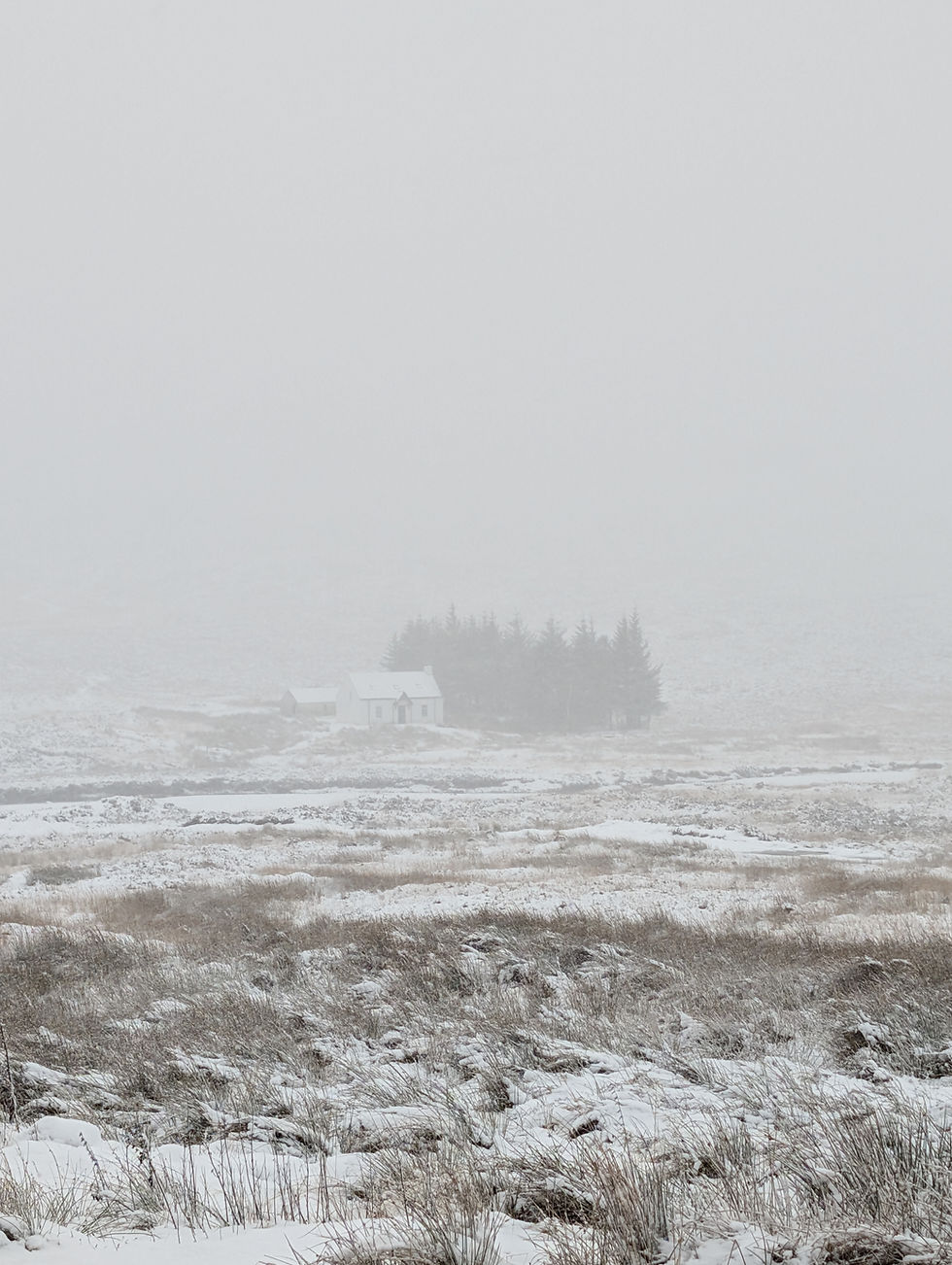
My little Citroën was not prepared for what I had signed her up for. I found myself sliding side to side on icy Highland roads, with nothing but a single cottage, shrouded in heavy falling snow, in sight. All I could think about was how this was definitely not something my father would have signed up for.
So instead of Skye, I spent my first night at the Glencoe Inn in the Highlands.
This turned out to be an excellent consolation prize. The inn had a whisky library, and with nowhere else I particularly needed—or, given the roads, wanted—to be, I started sampling my way through Scotland. Until then, Scotch had been something I liked but was only minimally versed in. Sitting there with a variety of distilleries and regions within reach, it became something I wanted to understand.

Learning about Scotch is helped by grounding it in geography. Scotland's whisky-producing landscape is divided into five official regions: the Highlands, Lowlands, Speyside, Campbeltown, and Islay. The distinctions aren't rules—two whiskies made in the same region or even at the same distillery can taste remarkably different—but they give a beginner a useful map.
Speyside is home to many of the names even a casual whisky drinker would recognize and is often associated with fruitier, sweeter drams. The Macallan and The Balvenie distilleries are in the Speyside region. The Highlands cover an enormous and correspondingly varied territory. Lowland whiskies have traditionally carried a reputation for being lighter and more delicate, while tiny Campbeltown, once one of the great centers of Scotch production, has survived with only a handful of distilleries.
And then there is Islay.
Islay is the region that tastes most like what I had originally understood Scotch to be: smoke, peat, salt, something a little confrontational. My introduction had been a glass of Laphroaig ordered by an ex, essentially throwing myself into the deep end of Scotch before I knew there was a shallow one. I initially hated it, but now Laphroiag is one of the distilleries I keep on my hidden bookshelf door. I no longer really engage with the "shallow end" of Scotch whisky.
Talisker complicates Scotch's geography in a useful way. Made on Skye and officially classified as a Highland single malt, it has the maritime character I would later come to associate most strongly with the whiskies of Islay, but it lakes that higher phenol parts per million (PPM) of especially peaty Scotches. Drinking it from the cask helped me understand something a map couldn't: regions are a useful entrypoint into Scotch, but they are not a set of flavor laws.
With a slightly better understanding of what I was drinking—and the roads finally clear enough to continue—I kept driving north the next morning.
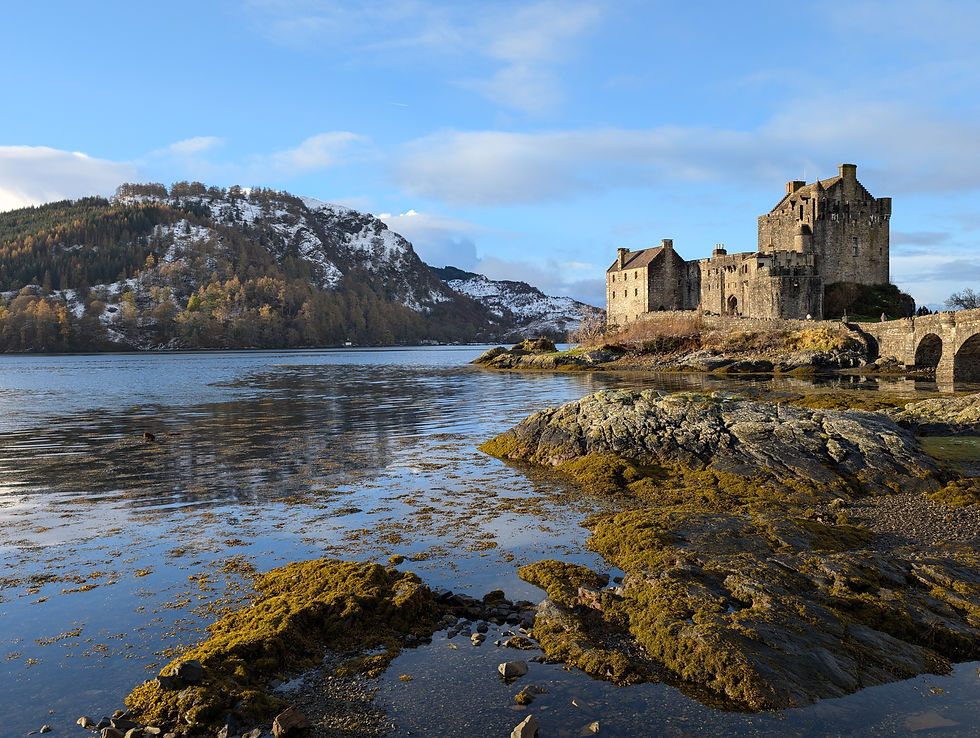
The landscape emptied out quickly. There were stretches of road where I seemed to be the only person for miles, interrupted by Eilean Donan Castle, so impossibly Scottish against the water that it hardly looked real. There were coos everywhere. Lots and lots and lots of coos. Truly. So many coos.
Eventually, I made it to Skye and, more importantly, to Talisker.
I managed to get a last-minute spot for a cask tasting at the distillery. Instead of simply being handed a finished dram, I got to pull samples directly from the cask. This was a little nerve-wracking, doing something that required dexterity in front of people I had only just met. My fear of spilling a dram all over the floor, fortunately, did not materialize.
After beginning the trip blindly sampling, I was now drinking Talisker straight from the barrel on the island where it was made. I felt like this gave me a better foundation and grounding as I would go on to learn of the distilleries and differences between the five Scotch regions of the country.
Then Scotland tried to blow me off a mountain.

I hiked the Old Man of Storr in winds strong enough that, near the top, I could feel myself being physically pushed backward. On the descent, I watched another hiker lose their battle with a gust of wind and go careening down the mountainside.
My introduction to Scotland had been messy, cold, occasionally alarming, and not particularly close to the trip I had imagined. I couldn't wait to come back.
Isle of Islay
The next time I went to Scotland was for my 29th birthday. This time, I knew exactly where I wanted to go: Islay, my favorite of Scotland's five whisky regions. Home to Ardbeg, Lagavulin, Laphroaig, Bruichladdich, the island had become a pilgrimage for me.
I was especially interested in Ardbeg. Its whiskies are unapologetically peaty, but the company itself has a sense of character and quirk that I hadn't expected from the sometimes self-serious world of Scotch. Given that LVMH (of Louis Vuitton) owns Ardeg, this begins to make a bit more sense. Ardbeg seemed comfortable being a little weird and over the top.

Given my love for the brand, I stayed at Ardbeg House, which seemed to be making the case that my home decor is nowhere near weird enough.
Everything was a little theatrical, a little excessive, and deeply specific to where I was. There was an--albeit easy--mini scavenger hunt in my room to locate two nips bottles of their flagship Scotch releases. I loved it. I also discovered that a beautiful breakfast downstairs from my hotel room is no longer a luxury I am willing to pretend I can live without.
There was just one problem with staying there: too much whisky to choose from.
The Ardbeg House bar has close to all of Ardbeg's releases available by the dram. There were so many expressions of Ardbeg available that choosing one started to feel absurd. I was grateful the pour sizes were a bit smaller than they would be in the States, because I wanted to take the opportunity to explore as much as I could. I tried The Beithir's Tale. It left me thinking of smoked butter. Fermutation was next. It was chewy and yeasty, almost like brioche. I kept notes of what I liked most and decided that Corryvreckan and the Twenty Something 23 Year Old were the top contenders for my favorite.
The more whisky I tried over the course of my weeklong stay, the less monolithic “Scotch” became. At Ardbeg, during the distillery tour, I learned how much room there was for experimentation within a distillery whose whisky has such a recognizable character. Ardbeg makes the intensely smoky, peated whisky Islay is famous for, but it also seems determined to find increasingly strange things to do with it. Fermutation, which I had tried, was born from an unusually long fermentation after a broken boiler interrupted production, turning an accident into a limited release. The Beithir’s Tale experimented with heavily toasted and charred bourbon casks. And then there was Alligator, named for the extreme charring of its casks, which leaves the wood cracked and scaled like alligator skin.
Alligator had become something of a white whale for me. It was a limited release, and I had the chance to sample it first in Zurich, off of the back bar of a restaurant. My only thought on tasting it was that I had found a flawless Scotch. I loved it enough that I paid far too much to have a tiny vial of it packaged for me to take home.
At Bruichladdich, I found myself just as interested in the history of the distillery—its closures and reincarnations—as what was being poured into my glass. Founded in 1881, Bruichladdich endured repeated closures and changes in ownership before being mothballed and sold in 1994. For seven years, the distillery remained dormant, until new owners revived its Victorian-era equipment and began distilling again in 2001.
Today, the same distillery makes three remarkably different single malts. Bruichladdich, the namesake, is unpeated—floral and elegant, and a useful corrective to the assumption that whisky from Islay must taste like smoke. Port Charlotte moves firmly into peat, at 40 PPM, giving it more of the smoky character I had come to associate with the island. And then there is Octomore, where Bruichladdich takes peat to its logical extreme: super-heavily peated, bottled relatively young and at formidable strength, yet capable of far more finesse than something that sounds, on paper, like it should punch you in the face. This finesse is thanks both to the shape of the stills and the type of peat that is used.
I loved that all three came from the same stillhouse. By this point, the neat regional map I had started constructing on my first trip was becoming much messier—and much more interesting. Whisky had been one of the reasons I came to Islay. Once I was there, it became a way of understanding the island.

For anyone planning a similarly whisky-focused trip, staying at Ardbeg House also provides a convenient geography. Ardbeg, Lagavulin, and Laphroaig sit along the same stretch of Islay's southern coast, close enough that there is little reason to turn them into three separate days. Give them one or two instead. If you're going to do a full tour at only one, I'd choose Ardbeg and leave the others for tastings—not least because scheduling every hour of a trip to Islay somewhat defeats the purpose. It could mean that you miss out on scoping out the little cake shed that sits next to the path between distilleries.
Lagavulin managed to surprise me in both directions. Wandering into the gift shop came with the unexpected delight of a complimentary dram—a small gesture that immediately made me want to linger. More surprising was what I couldn't find. Despite Lagavulin's much-publicized collaborations with Nick Offerman, there wasn't a single Offerman Edition available to taste in the dram shop when I visited. I had traveled all the way to the source only to discover that one of the bottles I most associated with the distillery was easier to find back home.
Laphroaig, meanwhile, was exactly what I expected. I stopped by for a dram by the sea, which is about as classic an Islay whisky experience as one could ask for. And, respectfully, I found it a little boring. I still love Laphroaig—the medicinal peat that once made me hate it is now precisely what I appreciate about it—but compared with the experimentation at Ardbeg and the surprises elsewhere on the island, the experience of visiting the distillery felt almost too expected. There are worse things than drinking an excellent Scotch beside the water on Islay, of course. But it turns out that once Scotland taught me how strange whisky could get, I wanted the strange stuff. For that, it was worth crossing the island to Bruichladdich.
I saved a separate day for the drive and was glad I hadn't tried to fold it into a greatest-hits distillery crawl. I'd recommend doing the same. The drive is part of the point. So are the things that interrupt it.
Mostly, sheep.
Something I learned on Islay is that I am extremely easy to entertain as long as there are animals to look at.
It was spring, which meant lambs—hundreds of them, scattered across fields alongside the road, occasionally bringing my progress around the island to a complete stop. Of everything I had come to Scotland to see, baby sheep somehow cracked the top five. Allow ample time for looking at farm animals.
By my second trip to Scotland, I was beginning to understand that what I loved about being there had as much to do with the absence of an itinerary as anything on one. I could walk for hours. I could work out. I could write. I could read a book, abandon a bad one, and start another. There was nobody waiting for me to finish getting ready and nobody whose opinion I needed on what we should do next.
Mostly, I liked being alone.
I hadn't come to Islay in search of solitude, but somewhere between the lambs, long walks, strange interiors, books, and whisky, I realized how much I valued it. There was something freeing about making every small decision entirely on instinct: when to leave a distillery, where to walk next, whether to stop the car simply because there was a cow I wanted to look at. I could change my mind without explanation and linger without worrying that someone else was ready to move on.
It wasn't that I didn't want anyone in my life. I was realizing that wanting companionship and wanting solitude aren't opposites. There are experiences I love sharing, and others that feel different when they belong entirely to me. Islay reminded me that needing some of both isn't a contradiction.
There was a particular luxury in having nowhere I had to be, no one I had to accommodate, and an entire island on which to follow whatever caught my attention. As it turned out, what caught my attention was mostly whisky and livestock.
Edinburgh
Both trips eventually brought me back to Edinburgh. Perhaps 80 percent of the city's allure, at least for me, lies in Gleneagles Townhouse, one of my favorite hotels I've ever stayed in.

I have an enormous appreciation for good hospitality, partly because I think it is an art that is extraordinarily difficult to get right. The best version isn't simply attentive, it anticipates what would make a guest feel cared for without making the care itself feel performative.
Gleneagles Townhouse has managed this on both of my visits. The first time I arrived, my room wasn't quite ready. Rather than simply storing my luggage and sending me out into Edinburgh to kill time, someone took me upstairs to Lamplighters, their rooftop bar, and settled me in with a cocktail while I waited. It was a small thing, but that is precisely what I remember about it.
When I returned for my birthday trip, they did it again. This time there was a complimentary room upgrade, with cake and a handwritten note waiting for me when I arrived. Neither gesture was necessary. Both made me feel as though someone had actually noticed why I was there.
That attention to detail is what keeps me attached to certain hotels, restaurants, and bars long after I've forgotten what I ordered for dinner or what brand of soap they stocked (it's usually Aesop). Luxury can be expensive linens and beautiful rooms, but hospitality is something different: the feeling that someone has been paying attention.
After days of whisky on Islay, Edinburgh also gave me something I hadn't realized I needed: a run. Much of the city is not exactly designed for effortless running—hills, cobblestones, crowds—but moving through it on foot felt nourishing after several days structured around distillery tastings. It was a reminder that sometimes the thing I want most on vacation is something I would have done at home.
I quickly developed favorites in the city. Noto and Vinette are two of the restaurants I return to not only because the food is excellent, but because of the attention to detail and genuine kindness of the staff. At Vinette, a freezer martini paired with fries is exactly the sort of uncomplicated luxury I want after a day of walking around Edinburgh.
Whisky may dominate the conversation in Scotland, but Edinburgh's cocktail bars deserve some attention of their own. Panda & Sons regularly appears on lists of the world's best cocktail bars, while Hey Palu brings an Italian sensibility to its drinks. There, ordering a Paper Plane becomes a game: construct the paper airplane that comes with the cocktail, successfully send it over the bar, and earn yourself a treat. For a deeper dive into Scotch, there is the Balmoral, whose extensive whisky collection is overseen by people who can help you make sense of it. Sitting with someone who knows the bottles well enough to guide you toward something you might never have ordered yourself is far more interesting to me than simply choosing the most expensive or recognizable dram on a menu. That’s how I first encountered Bruichladdich’s Octomore releases. On another visit, a member of the team introduced me to Ledaig, the peated whisky made on the Isle of Mull, and later gifted me home a bottle from Chorlton Whisky. Chorlton is an independent bottler: rather than making whisky themselves, they selects individual casks from distilleries and bottles them as singular expressions, often at natural cask strength. The Ledaig became enough of a favorite that, a couple of years later, I returned and centered an entire tasting around it—much to the delight of another staff member, who happened to be from the Isle of Mull.
That exchange is also one of my favorite things about traveling alone: collecting other people's recommendations. A conversation turns into a place I have to try, scribbled onto a business card, notecard, or random scrap of paper. At Bramble, the team sent me away with a handwritten list of other places they thought I might like. I cherish these little artifacts and hold onto them.
Maybe that's because I like the idea that a trip can be preserved.
I struggle with what happens when a memory becomes complicated. When you plan a trip and spend the money on it, you want everything to be perfect. No illnesses. No spills that leave the top you planned to wear three more times at the mercy of the hotel laundry service. No missed ferries, bad meals, or disappointments you're going to have to edit out when you tell an eager listener about the trip later.
But travel is still just living your life in a different place. If anything, it's life on hard mode. You're constantly choosing novelty over familiarity: a bed you've never slept in, roads you've never driven, food you've never ordered, people you've only just met. That's part of what I love about it. As writer Kristin Newman has observed, travel gets us out of the mental ruts where we spend our days thinking some variation of the same handful of thoughts. It also means that all the ordinary messiness of being a person comes with you. What I find harder is when the messiness arrives later.
A place can remain exactly where you left it while your relationship to the memory of it changes. Something that felt wonderful when it happened can become harder to look at directly—not because the experience wasn't real, but because you know something now that you didn't know then.
I don't like that. I want a good memory to stay good. I want to preserve a trip exactly as I experienced it, untouched by whatever happened after I came home.
But perhaps that's asking something of travel that I wouldn't ask of the rest of my life. Something that happens later can reach backward and alter a memory that was genuinely happy when you lived it. I used to think the task was to prevent that—to keep the good trips good, the photographs flattering, the stories uncomplicated.
I'm trying to become less interested in preserving them.
Scotland has never particularly cooperated with my plans anyway. I went to Skye and ended up stranded by snow in Glencoe. I went for whisky and became preoccupied with cows. I went to Islay for distilleries and spent an unreasonable--in the best way--amount of time watching lambs.
My third trip is already in the works.
I'll make the reservations I need to make. I'll check the ferry schedule. I'll know which whiskies I want to drink.
And I'll leave room for Scotland to interfere.